


Alright, I’m calling an audible.
Last week, when I announced the new Will Spencer Book Club, I selected for our first book The Myth of Mental Illness by Thomas Szasz. It’s a compelling and important work, and one I intend to return to.
But in the meantime, I’ve realized something.
There is one book I have recommended more than any other over the past year:
Black Sun: Aryan Cults, Esoteric Nazism, and the Politics of Identity by Nicholas Goodrick-Clarke.
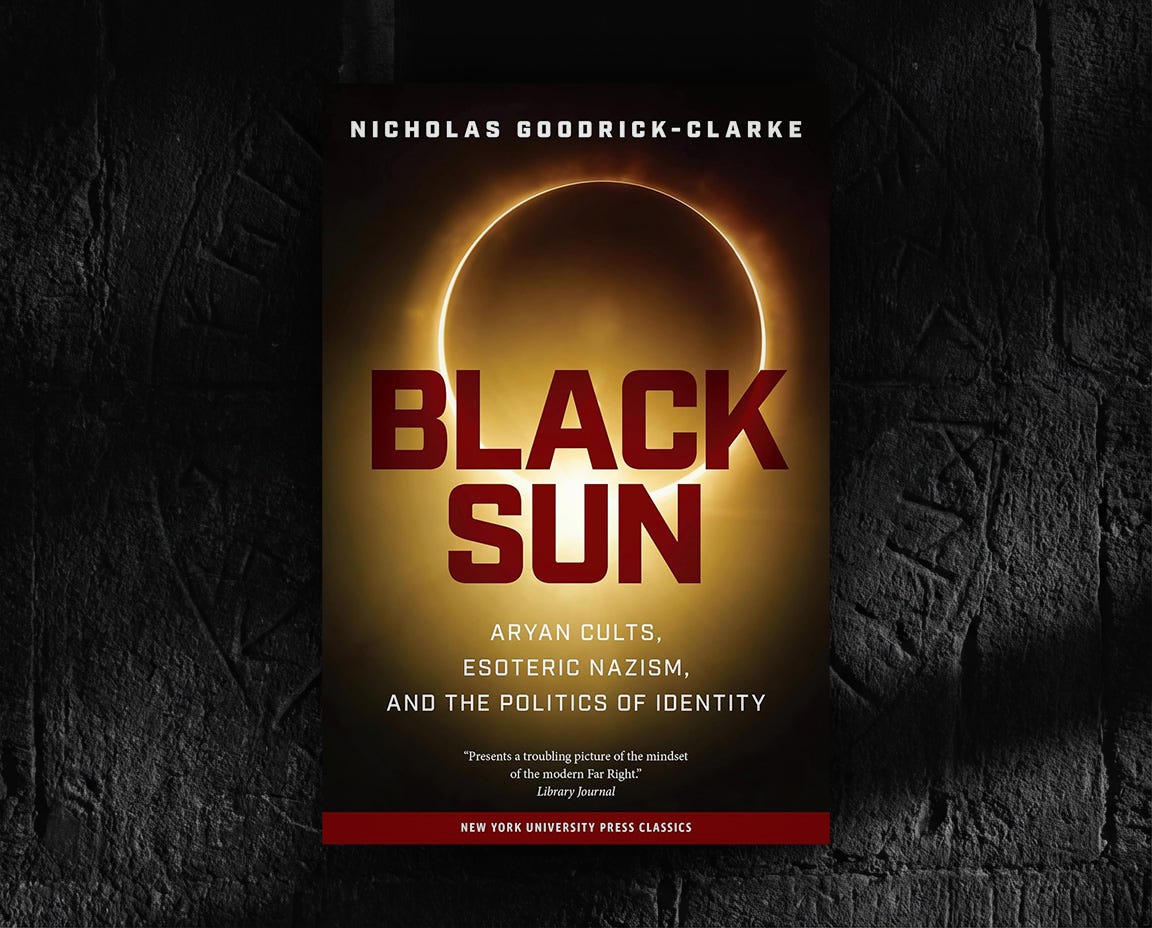
Over and over again, I hear from men and women, fathers and mothers, pastors and educators, asking the same question:
“What is the best book I can read to understand this whole Neo-Nazi phenomenon on the right?”
This is always the first book I point them to.
Black Sun documents the rise of Neo-Nazism in America, the UK, and Europe after the Second World War. The story begins in the 1950s and ends in 2002, when the book was written.
That timeframe matters. Because the events Goodrick-Clarke describes predate the internet. This is all before Reddit, before 4chan, before anonymous message boards, livestreams, and algorithmic radicalization. What the book captures instead are the deep roots and the slow incubation of ideas that would later explode into public awareness once digital tools made them viral.
If we want to understand what we’re seeing today, we have to understand what has already been happening for decades, quietly and out of sight.
Black Sun has become the lens through which I view much of our current moment, without realizing it. I take it for granted. So when I try to explain to pastors what I’m seeing, many of them don’t believe me.
My hope in sharing this book is to remedy that, for as many readers as possible.
Long Before the Memes
Because what struck me when I first read Black Sun, and what still strikes me today, is how little of this is actually new. Goodrick-Clarke is not describing a sudden eruption, which is how it appears to most observers. Instead, he’s describing a continuity.
Writing in 2002, he opens the book by noting:
“Black Sun examines the survival and revival of ‘Aryan’ racial ideas in response to the challenges of the postwar world. More than half a century after the defeat and disgrace of Nazism and fascism, the far right is again challenging the liberal order of the Western democracies for political space.
Radical ideologies are feeding on the threats of economic globalization, affirmative action, and Third World immigration. Nazism is revived as an extremist response to communism, liberalism, and more especially the desegregation of African Americans and colored immigrants.
However, despite their overriding concern with colored races, neo-Nazi ideology still identified the Jews as the demonic adversary of the white Aryan peoples. Here the Jews are regarded as the architects of a multi-racial world order, which supposedly dissolves all nations, traditions, and loyalties, before the final accomplishment of Jewish world conquest.” (pp. 2-3)
Does all that sound familiar?
Remember, this was written before social media, before meme culture, and before the hyped-up digital marketing of these ideas.
What Goodrick-Clarke describes has taken a new shape for a new era. I’m not making this up, nor am I imagining it. This is real.
And now it’s in our timelines, families, and churches.
WHY BLACK SUN
I want to read this book to demonstrate three crucial points:
1. Modern Neo-Nazism is not primarily political, it’s religious.
One of the most common mistakes people make is assuming that Neo-Nazism today is simply “politics gone too far.” The frequent claim is that left-wing excesses of yesterday are driving the right-wing excesses of today.
Goodrick-Clarke demolishes this assumption.
What he documents is not merely a political identity, but a mythic and occult worldview. The view blends paganism, esotericism, pseudo-history, and spiritual rebellion into a coherent religious vision.
These movements are animated at their core not by concrete policy goals, but by cosmology. Not by winning elections, but by initiation, symbolism, and myth.
This matters because you cannot argue someone out of a religion using policy proposals.
But more importantly, you cannot counter a counterfeit spirituality without first recognizing it as spirituality.
2. “Irony,” memes, and aesthetics serve a dangerous purpose
These movements understood something that modern conservatives often miss: ideas move through symbols before they move through arguments.
Runes. Suns. Myths of lost civilizations. Cycles of decline and rebirth. Initiatory language. A sense of hidden knowledge possessed by the elite few.
These aren’t accidental flourishes. They’re recruitment tools. And they’ve been spreading online for years through memes, hidden symbols, and viral video edits.
Goodrick-Clarke shows how Neo-Nazi groups deliberately framed themselves not as hate movements, but as “keepers of forbidden wisdom.” This appeals to intelligent, alienated young men searching for meaning, hierarchy, and transcendence in a society they feel has abandoned them.
If you want to understand why some online subcultures feel more like secret societies than political movements—and why that gives them such seductive power over men—Black Sun will explain why.
It also explains the tribalism of the anons, and why many leaders prefer to signal allegiance to those tribes, rather than sanctify them.
3. Christians today are not seeing the battle correctly
Perhaps most importantly, Black Sun strips away the illusion that we’re dealing merely with “bad ideas” or “edgy politics.”
What Goodrick-Clarke describes is a spiritual revolt. These movements define themselves in opposition to true Christian morality, Christian anthropology, and the universal Christian promise of salvation. They reject repentance, humility, and grace, replacing them with blood, destiny, and mythic struggle.
In other words, this is not just a social problem. It is a discipleship problem.
Only now it has changed shape, reframing bad ideas in Christian-sounding terms for a generation of young men whose knowledge of the faith comes from memes, tweets, and attention-seeking podcast hosts.
And if pastors, fathers, and educators do not understand the spiritual nature of this threat, they will keep fighting it with the wrong tools.
Why This Is the First Book for the Book Club
When I announced my Book Club, I titled the post, “I Read Books to Relax. I Read Books to Fight.”
The kind of therapeutic sentimentalism Thomas Szasz critiques is worth fighting against. But it isn’t the fight right now.
This is.
In the wake of October 7 and the assassination of Charlie Kirk, anti-Semitism—or, hatred of the Jews—has taken hold on the right to a stunning degree. Many assume it’s driven by simple ethnic or religious animus. It isn’t.
What’s motivating it runs deeper: a worldview, an anti-Christ religion, and an offer of tribal belonging to young men who are in the process of rejecting inherited wisdom and authority in favor of the brute force of the symbol-drenched strongman.
As I’m fond of saying, I don’t make the rules, I just work here. This is what’s happening.
I believe Black Sun can show you.
A Word of Caution
This book discusses real darkness in clear terms. Like all works that address the occult, it’s not for casual curiosity.
Black Sun doesn’t sensationalize evil, but it does take it seriously. That means it names, documents, and explains belief systems that are genuinely destructive.
If a man is drawn to forbidden knowledge for its own sake, untethered to healthy Christian community, or if he’s prone to lose discernment through fascination with the forbidden, this is not a book to read lightly or alone.
But for pastors, fathers, mothers, teachers, and mature believers charged with the care of souls, this book is an important tool. We read it to recognize error, aiming not to be impressed by darkness, but to strip it of its mystique and shine Christ’s light into it.
Scripture tells us that, as Christians, we must not be ignorant of the enemy’s schemes (2 Cor 2:11). It also commands us to take no part in the unfruitful works of darkness, but instead to expose them (Eph 5:11).
That means we must not remain naïve.
So together, we’ll read this book prayerfully and soberly under the authority of God’s Word, and within the life of the Church.
Our aim is not to become experts in darkness, but to become men who can see clearly enough to feed the sheep, shoot the wolves, and guard what has been entrusted to us.
Join the Book Club
To understand what’s really forming young men right now, beneath the memes, personalities, and slogans, this is where we need to begin.
The Book Club will take place on Zoom every other week, and is available to my paid Substack subscribers.
If you want more details about the Book Club format, schedule, and how it works, you can read the original announcement here.
And if you know pastors, parents, teachers, or friends who are asking the same questions, tell them about this book and invite them to read with us.
Let’s read, and fight.
Become a paid subscriber today:
Very important message, but as a German I gotta correct you on one tiny little thing. National Socialism (that's what it called itself) ALWAYS had a VERY STRONG occult and esoteric component based on Theosophy and its derivatives such as Ariosophy. That was ALWAYS a core component since its very inception and it was always very anti-Christian. Though that's less apparent since they tried to undermine it from within and even had their own form of Christianity with their own Bible - yes, they literally re-wrote the Bible - think about that.