


What do you think the most important piece of technology in history is?
The wheel? The printing press? The steam engine? The microchip? All of these reshaped civilization in profound ways.
But there’s a far more powerful technology than any of these. It lets you sit at the feet of men who died a thousand years ago. It lets you shape minds that won’t be born for another hundred. You might have one within arm’s reach right now. And it contains the potential to reshape your life overnight:
The book.
You might not be accustomed to thinking of “books” as a technology, but they are. You just have to learn to see it for what it is. To quote George Orwell,
“To see what is in front of one’s nose needs a constant struggle.”
So let’s look at these things we’ve got stacked in front of our noses.
First, someone had to invent books as a method to contain vast amounts of information in portable form, preservable across generations.
Grab your nearest book, especially if it’s the Bible. Consider the vast amount of historical, linguistic, and narrative information it contains. Now add to that the theological content. It’s all available in a package weighing less than a pound.
Just like microchips, which were invented centuries later, the book started as an unwieldy and expensive thing. Now you can get the greatest works in human history for free... and carry one in your pocket.
But unlike a microchip, a book doesn’t require a power source or a connection to anything beyond itself. All it needs is knowledge of language, and light to read it by.
Second, and more importantly, consider the effect that just one book can have on your life. Join me for a thought exercise: Besides the Bible, what book has had the biggest impact on you? What were its physical dimensions? How much did it weigh? How much did it cost you to buy?
Now contrast that with the effect the book produced in your life. Was its power far in excess of its physical dimensions and cost? Almost definitely.
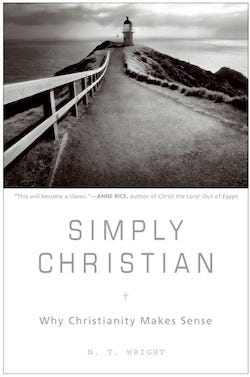
A good example for me is the book “Simply Christian” by N.T. Wright. I read the hardcover edition of the book. According to Amazon, it weighed 14.4 ounces—less than a pound—and occupied just 54 square inches of space. Even better, someone gave it to me as a gift. As in, it cost me nothing.
But it was the first book of Christian apologetics that I’d ever read. It played a pivotal role in my life, directing me towards Christ after 20 years of seeking.
I cannot tell you who I’d be today if I had not read that book. It might be one of the most powerful single objects I own. And the same is probably true for you. I’d even argue that everyone can name a book that’s had a similar impact on them.
This is why I think the book is the most powerful technology ever invented, made all the more so by its ubiquity and humble form.
THE CARTOON THAT CHANGED MY LIFE
With that in mind, years ago I found a cartoon that poetically captures the power of this technology. As a result, it’s lived rent-free in my head ever since.
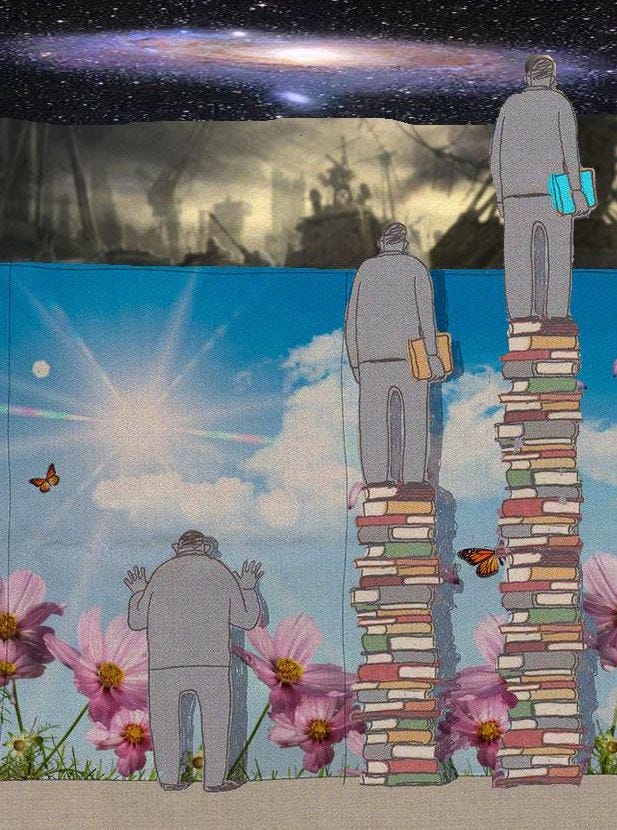
There’s a lot going on here. Let’s walk through it together.
The cartoon depicts three men, each standing on a different-sized pile of books. The pile represents how much they’ve read—and determines what they can see.
The first man is standing on no books at all, signifying that he’s not a reader.
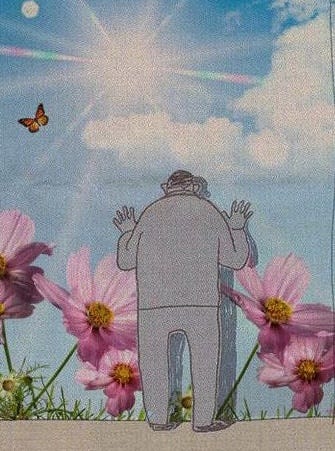
While at first he appears to be looking at a beautiful landscape with flowers, bright sunshine, and even a butterfly, he’s actually staring at an image painted on the surface of a wall. His hands and face are pressed against the image. You can see his shadow cast against it, along with the other men’s. If you look closely, the scene also has a subtle printed texture, almost as if it’s wallpaper.
The point is, he can only see that which he’s being shown. And the image is a lie meant to pacify him. There’s no substance to it, only illusion, and it has him transfixed. If you look closely, his rounded shoulders, humped back, and protruding ears suggest he’s meant to be seen as simple-minded—not necessarily malicious, just unquestioning. Perhaps even as a permanent condition.
The second man is standing on a moderate pile of books, with one in hand.
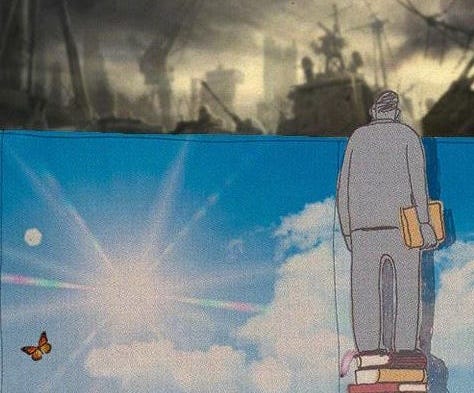
The books have elevated him above the first man, so he’s staring above the wall of illusion. But the scene he’s looking at on the other side has a character all its own.
It’s grim, industrial, dystopian. Buildings tilt on their very foundations, as the ghostly forms of construction equipment fade into the smoggy background. A circular shape in the center draws the eye. Is it a window? A clock? This might be the only recognizably human element in what otherwise could be a junkyard.
Reading some books is better than none. He’s seeing real (or real-ish) things. In one sense his condition has been improved, because at least he’s not ignorant or simple-minded.
But seeing past the illusion comes at a cost. What’s behind the wall isn’t pretty.
Thankfully, that’s not the end of the story. The third man stands on a pile of books even taller than the second. And his view has been significantly improved.

Because he looks out over a cosmic vista: a spiral galaxy nestled in a field of stars. The image is grand, inspiring, hopeful.
The message? This is the reward for a life well-read. If we read enough, we won’t perceive illusion or dystopia. We’ll witness reality itself in all its complexity, beauty, and harmony.
WHY I READ
The cartoon captures in a single image the reason why I read as much as I do.
I feel compassion for those who don’t, like the man standing in front of the wall. The trap that holds him is real. But I also feel compassion for those who don’t read enough. They’ve begun their journey, but haven’t yet earned the full reward.
Only by reading until we break through both illusion and disillusionment can we experience the truth, and be edified, inspired, and transformed by it.
All through the simple technology of the book.
JOIN THE ADVENTURE
I’ve spent years climbing my own stack. And I want to help you do the same.
That’s why I’m launching The Will Spencer Book Club, only here on Substack. A place to read the books that matter: theology, history, philosophy, culture. The kind of books that don’t just inform you, but transform you.

Books that tear down walls of illusion. Books that carry us past the temptation to despair. Books that let us see reality as it truly is: complex, beautiful, and suffused with the glory of God.
I don’t want to take this adventure alone.
Paid subscribers get access to twice-monthly Zoom calls where we work through what I’m reading, together. I’ll share insights from the assigned reading and offer time for questions and open discussion. Each call is recorded if you can’t attend live.
We’ll aim for roughly one book per month, about 10 pages per day. Achievable for almost anyone.
Our first book will be The Myth of Mental Illness: Foundations of a Theory of Personal Conduct by Thomas Szasz, M.D.
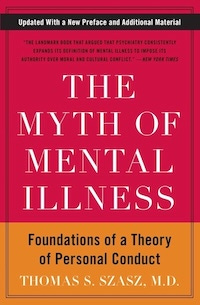
Fifty years ago, a practicing psychiatrist predicted that psychology would swallow morality, turning spiritual conditions into medical ones. His radical claim: we need a return to moral frameworks, not more medicine. I’m starting here because therapeutic sentimentalism might be the most pressing challenge the church will face in the coming era.
Want to help navigate the adventure? Signature Members get to help select our books, plus all the benefits of a paid subscription. [Learn more about the Book Club here.]
The unlearning begins. Join me on journey past illusion. Become a paid subscriber today.